
If you have heard me speak about my history with dog training, you may very well have heard me say that it was acquiring my African Grey parrot, Barnaby, close to 26 years ago that initially got me interested in studying Applied Behavior Analysis (ABA) and pet behavior. At the time, Barnaby had become my third pet bird, and he thought it would be cool to produce ear deafening noise. I did not; however, think it was so neat. Parrot screaming issues are one of the most common complaints in households, yet the problem is solvable. I am sharing what I did and tips that may help you.
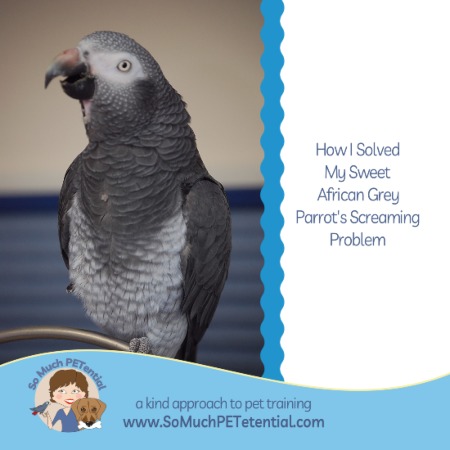
Way back then, I did not have the knowledge I have today. I was just a pet guardian looking forward to having a talking African Grey. So, when my little boy decided his first sound would be imitating my Alexandrine Ringneck Parakeet (who sadly passed years ago) at decibels way beyond what came out of Chester…throughout the day, I just needed it to stop.
NOW!!!
I tried the strategies I read online – talking to him in quiet words, yelling NO, trying to ignore him, cover his cage. (Thankfully I did not squirt him with water.) Nothing worked.
I was at the end of my rope when I discovered an international online list of Dr. Susan Friedman, Ph.D., that taught parrot owners like me about ABA to live successfully with their pet.
What she taught me was life-changing and relationship changing. Susan was my first teacher/mentor. She is the reason my boy today speaks human much of his day. She is also the reason why I became hooked on studying behavior.
Why Do Pet Birds Scream?
Screaming is a communication behavior. Sure, they may scream for attention, but also, they may vocalize to alert of danger, to communicate with their flock, or their behavior can be cued by something in the environment.
In our homes, we must look at what happens because of our bird vocalizing to have a better understanding of what is strengthening it.
At that stage in our relationship, Barnaby picked up Chester’s sound to communicate with Chester but then it also worked to get my attention, so he got a double reinforcer. Chester did not scream with much frequency but he was a very active clown. I saw him as the instigator.
Changing My Bird’s Behavior
NO reinforcement for Barnaby’s screaming. NONE. PERIOD.
If I was in the room, I would calmly turn my back and walk out. Sometimes with Chester. If I was not in the room and he screamed, I froze. Any movement or sound may have inadvertently reinforced his screaming.
However, just ignoring behavior alone is not a good plan as it can create a lot of frustration. That frustration can lead to the animal increasing the strength of that problem behavior, which is called extinction burst. Or the animal may begin showing additional behaviors. In this case, it could mean louder screams and possibly banging on a bell. (It did not but it could have.) If you give in and pay attention (which can easily happen as these are difficult behaviors to keep ignoring), you will have reinforced the intense vocalizations. See this post on extinction burst as it relates to dog training.
Reinforcing An Alternative Behavior
This is referred to as differential reinforcement of an alternative behavior or DRA. While I was ignoring his screaming, I found a different sound to heavily reinforce instead. Each and every time he would make that chosen sound (at first it was a whistle until I realized he could whistle pretty loud, then it became ‘mommy here’), I immediately ran into his room. The contingency I wanted Barnaby to learn was ‘WHEN’ I scream, ‘THEN’ nothing happens. ‘WHEN’ I say, Mommy Here, ‘THEN’ I get instant attention.
Over time, I was able to get to a point where I sometimes went to him and other times just spoke back to him.
Increased Enrichment
Part of my plan had to be making sure that Chester had enough mental and physical stimulation to meet his biological needs. Alexandrines are voracious chewers. I made sure to stock his cage with a lot to chew on, tear apart, and figure out.
Since Barnaby would scream as I left their room, I would give him something to work on prior to my leaving.
I also gave Barnaby plenty of foraging and other activities (that HE was interested in) so that he would need to communicate less.
And this is why today I have an African Grey companion who has conversations with me when I am upstairs. It is interesting as I also have a pionus, Dreyfuss, who is very old. She is mostly quiet and very infrequently let’s out a few screams. When she does, if Barnaby wants to communicate with her, he will scream like her. If he wants to communicate with me, he will respond to her scream with ‘Barnaby is a good boy.’
And, of course, I have to agree!