
Crate training your puppy can begin early so long as your goal is to teach your puppy her crate is a comfortable, cozy, safe place to relax and sleep. With a young puppy needing upwards of 18 to 20 hours of sleep a day, there is a lot of time to practice.
I’ve heard it said often that to crate train, feed your puppy there. Here is the thing, if your puppy does not feel safe being closed in, feeding your puppy in there and then closing the door, has the potential to cause your little one to fear that food (and fear the crate).
And also, this is a very important time to help your puppy just settle in and know her new surroundings are a safe, happy place.
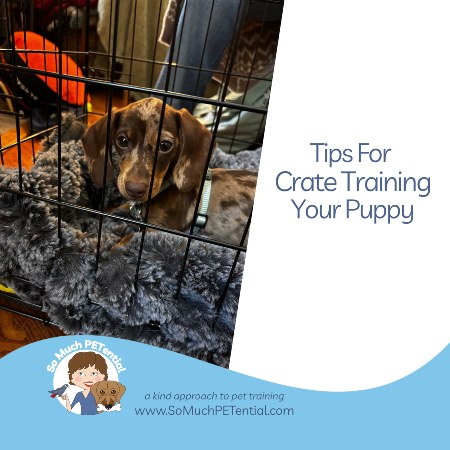
This precious little girl, a miniature dachshund puppy new to her home, spent time playing in her pen and then learning through playing with us before this video. We knew she was tired. We could see it in the shift of her behavior.
A perfect time to work on crate training.
You can see, they made it super soft and cozy.
I gently coaxed her in, softened my voice, sat beside her, and gave her tiny flavors of treats as she began to relax. There were a few times when she got up and came out. That is ok. It is important to give her that choice. There is no force here.
Then she came back to her comfy spot and we began again. Crate training should look very boring. It can take some time for you to be sitting beside it, so plan on reading a book, watching tv or talking with family.
You can see how, over time, her sweet eyes were beginning to close. Eventually, she laid her head down.
In this phase, don’t worry about closing the door. Stay nearby even when she is sleeping. However, if your puppy is ok with you closing the door, go ahead and do that but watch to make sure your little one is still comfortable. You can open and close the door too, it just depends.
Over time, you can begin closing the door more while you stay close. Then you can begin closing it and moving around.
It is important that you not just put a puppy in the crate, shut the door and walk away.
That can backfire and create a lot of distress. This is a systematic process. Ironically, the slower you go, the faster this will go.
Since this video was taken the first time this training began, this little girl was not asleep when it came time for me to leave so I had my client pick her up and bring her with us, then go back to resting in the crate when I was gone. I bet she was asleep on that comfy cushion in no time.
How you move forward will depend on the puppy in front of you.
It is also a good idea to have a webcam camera for when you do begin moving around, and even walk out of the room…and eventually out of the house. You want to make sure you do not see distress. Come back in prior to your puppy beginning to bark.
I am so glad I finally got a video of working through this to share!
Can I be of more help to you and your puppy? Please reach out!