
I have a reminder for everyone who trains their dog with positive reinforcement (which I’d love think all of you do). This goes for training your parrot, or any other animal for that matter. If you assume that you are using reinforcement because you think your dog will value something, you could be wrong.
ONLY your pet gets to decide what IS reinforcing in THAT moment.
It is easy to assume that whatever it is you are using as a consequence to your pet’s behavior is a reinforcer…but the truth is, assumptions are just that.
I can’t tell you how many times clients prepare treats for our lesson, only to have their dog disinterested when their dog smells what I have in my bag.
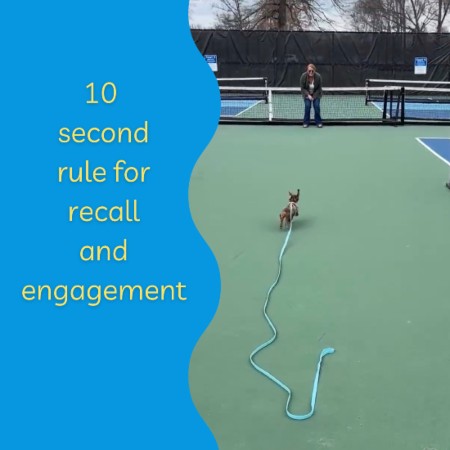
Even with my own dog, while there are plenty of times when Dawson’s kibble is value enough, when he CHOOSES to leave what he was barking at and sprint toward my back door after I call, THAT is NOT one of those times. Experience has taught him that bolting toward me even when there are other valued options, results in a fun game of ‘find it’ with what HE considers high value. (Typically, that is either my homemade treats, pieces of brick cheese, or Happy Howie treats.)
These high value treats, then, are positive reinforcement because his running to the door has increased in frequency and strength. That is the ONLY way I know if what I am using, is actually reinforcing for him.
He may come once or twice if I go back to offering him kibble when he comes in, but I bet his recall will weaken as a result. I want his recall in this situation to be strong so I am consistent in giving him a consequence that HE thinks is totally incredible.
Experience has also taught me that Dawson will do just about anything for a burst of one or several of those treats, so I also bring those along on walks in case we need to walk past geese or another dog.
In these cases, Dawson’s turning back to engage with me is reinforcing my behavior of bringing homemade treats, brick cheese and/or Happy Howie pieces on our walks.
There are lots of angles to look at that.
Here is another example of where assumptions about positive reinforcement in dog training can be wrong.
I see many people praise their dog for coming to them by leaning and bending over to rub their dog on the head, but many dogs will lean or move away when this happens.
In this case then, what was intended to be a reinforcer may be punishing the behavior of coming when called instead. A negative consequence was added to their dog’s environment, which is positive punishment and can result in their dog coming less to avoid being rubbed on the head. I have seen that happen a lot.
The only way you will know if what you are using is actually a reinforcer is by observing the impact of that consequence on the rate of the behavior. If you see more of the behavior, it is being reinforced. Otherwise, it is not. And sometimes, what you intend to be a reinforcer can be a punisher if you see less of the behavior because of the consequence.
Remember that the value of any reinforcer can and often does change depending on a lot of factors – the environment, the animal’s health, the animal’s activity level, genetics, as examples.
Practice being observant of your dog. Your dog will tell you what he does or does not value, what is or is not within his abilities at the time, how he feels.
And practice using that knowledge to help you be a better, more inspiring kind of teacher.
Oh…and of course, have fun!