I use food all the time when I am training dogs. Dog treats are easy to carry, typically of value to the dog in front of me and allow me to get a lot of repetitions of a behavior to reinforce in a short amount of time. However, there are times when a dog is not motivated by the dog treats meant to be reinforcers (either mine or my clients’). Why would this happen when a dog is biologically wired to eat to survive? If you have experienced this, here are some reasons why your dog may not be motivated by treats.
- There is something medically wrong with your dog.
Possibly it could be a sign of an underlying medical issue, including that your dog is experiencing pain, gastrointestinal upset, and/or has a sensitivity to something in what you are feeding him. If your dog normally eats what you are giving him, and suddenly refuses it in the same situation, it is time to consult your veterinarian.
- Your dog is scared or overly stressed.
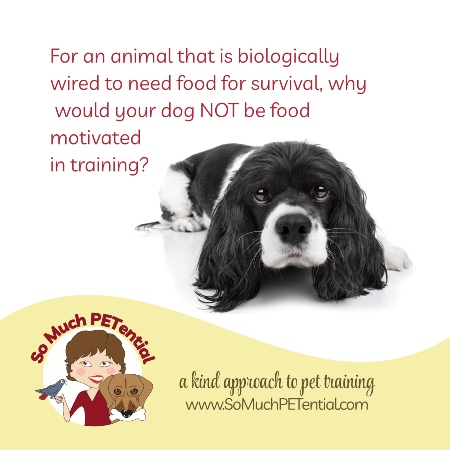
A medically healthy dog’s willingness and interest in food tells us a lot about his emotional state. Turning away from treats (and other dog body language indicating stress ) is a symptom that your dog is not feeling safe or that your dog is in an extreme state of stress – good or bad.
Fear can absolutely impact appetite. (Has this ever happened to you?) Stress hormones are released causing the body to respond in survival mode. Eating is not a priority in this state.
If you are seeing body language indicating fear and/or high stress, be proactive in getting your dog to a place of safety. This may mean creating greater distance from whatever is the cause or removing your dog from the environment. Then, you can consider the triggers and come up with a plan to support your dog’s needs (including seeking qualified professional help as needed).
- There are available competing reinforcers.
A pond to jump in. A squirrel to chase. Other dogs playing in the distance. A ball laying on the ground. If your dog REALLY wants to engage in these activities, in that moment, they are more valuable to your dog than the treat you are offering to pay attention to you. (And a single dog treat? Very unimportant at that moment!)
There is a lot to unpack with this one. Firstly, if you have not already taught your dog that paying attention to you is worth his time and energy, then there is no way you will be able to compete with the joy those activities can offer your dog.
The time you invest into teaching your dog that YOU have the power to make fun happen and that through YOU, there are opportunities to do those fun things will be well worth it!! And there are many ways you can make that food more valuable, livelier for your dog.
- History has taught your dog that food is a trap.
It is very, very important to remember that animals learn by consequences of their behaviors. If, in the past you have used food to lure your dog into doing something aversive (such as to come, when coming will result in something your dog does not like; to get close to people he is afraid of; or to go into a crate where he will be locked up for hours); experience will have taught your dog that the presence of food comes before something negative.
Always keep in mind that it is what occurs AFTER something, that affects the emotional response of what occurs BEFORE (in classical conditioning); and, through operant learning, animals learn whether a behavior is worth repeating or not. If a behavior serves to get the animal something of value (from the animal’s perspective), then that behavior will be repeated and even strengthened.
The lesson here is that you need to be careful about how and when you are using food with your dog so that you do not inadvertently poison your dog’s association with those treats.
- Your dog simply is not hungry.
This is self-explanatory. In theory, if your dog is full, he is going to have less motivation to work for food. This may or may not be true for your dog. There are many dogs who, even though they have just eaten, will still want to work for dog treats. There are a lot of other factors to look at too.
I know for me, I LOVE soft serve ice cream cones with sprinkles! Even after eating pizza, if you tell me it would only be an extra five-minute drive to the nearest ice cream stand, I will gladly follow your directions!
Please keep in mind that you do NOT need to nor should you deprive your dog of food to train. In fact, an overly hungry dog may become frantic, anxious, or unable to think clearly (That can happen to me too).
It could also be how you are training.
This opens a whole pandora’s box. I do want to address a few things here. Dogs, just like us, who feel pressured to learn in a class that is too difficult for them to experience success are not going to be very motivated to stay enrolled (if given a choice), and they could shut down or show other signs of frustration. Food is not the issue here. Your dog not seeming motivated to work for food in this scenario, is indicative of other aspects of your training that can be changed and improved.
No matter what, it is always a good idea in dog training to know what your own dog values. Are there certain foods he chooses over others? Are there activities he loves to do? Keep in mind that what your dog values here and now, may not be the same at any other time in any other situation. Listen to what your dog shares in the moment and be open to adjusting what you are doing.
Teaching and learning are always a two-way street. It is important for us, as teachers, to see ourselves as our pet’s coach, security net, and giver of fun. We all want to work harder when we feel seen, heard, and valued. Our pets are no different.