
As I have been receiving such an influx of calls for support with dog behavioral issues like fear, anxiety, aggressive behaviors, and dog-to-dog interhousehold conflict, I thought I’d share more of my own personal journey with my little buddy, my dog, Dawson. If you have been following me for a while, you have seen many posts about Dawson – most are fun, positive examples of our life together. Occasionally I mentioned generalized anxiety in my dog. This is more of Dawson’s story.
When I tell people my dog, Dawson, has generalized anxiety, I often hear back, ‘he just seems like a happy boy’. That makes me smile. REALLY smile.
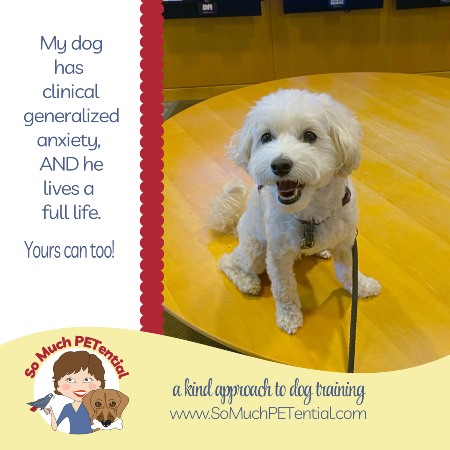
Because much of the time these days he truly IS a happy boy. The path to where we are today has not always been easy, nor has it been a straight line forward. During our eight years together, I have learned how to manage his world, his needs and his triggers; what behaviors would be most helpful to teach him and how to do it; and how to advocate for him, seeking the best qualified medical support.
If you meet Dawson and me outside, more than likely you would have no idea. If you go about your business and ignore us, he will walk past you, able to react in a split second to cues that I give him. But, if you admire him, he will likely happily run your way, wagging his tail in bliss as he moves around you, jumping and wiggling. If you are sitting on a bench, and especially if you have food, (if I allow him) he will walk toward you and sit in the grass until you notice his presence and invite him over (or I call him away first). On occasion, when I get the sense you will welcome him, I may allow him to bypass sitting and run right over to hop on your bench next to you.
However, if you happen to be walking a large dog, know that I will keep our distance. With a medication change (which I’ll mention later), he does much better, but he still would struggle with seeing a large dog on a leash within about 100 feet.
And, if you see us walking through a store, practicing his leash behaviors, you may ask me – as so many people do – if he is being trained as a therapy dog. He can be that good. If you ask us whether you can pet my dog, I will tell you he would love to say hi…he will not, however, sit still for you to pet him. That is just who he is.
You may also have seen my videos of our dog training. Dawson loves to learn. Maybe I am bias but I think he is brilliant!
However, even with his medication, even with the planning, those anxiety demons still appear at times, I just do my best to minimize those times.
Anxiety can be this insidious with humans too. Mental health issues are real, and many suffer invisibly. I am glad that many can talk about it now without stigma, to get help, so they can experience more joy and stability.
My dear dog has changed my life in so many ways and fostered a greater understanding of behavior. He has taught me important lessons in love, acceptance of imperfections, and being open to new paths in life. He has taught me about what it is like to experience a relationship with a dog who has general anxiety, and how to support that beloved pet.
Dawson presented many challenges and has given me a deeper empathy for others who also share their life with a dog experiencing mental health issues. It can be stressful. It can be a huge energy drainer. And yet, through it all, you feel so bad because you know, if this is such a source of stress for you, you can only imagine the kind of daily stress your pet is experiencing.
I hope my sharing this series of Dawson’s life will be of help you and your family dog.
Dawson’s Story – the early days
Before bringing my little buddy home, I had dreams of him accompanying me one day to events and outdoor restaurants. Of him joining me as a therapy dog to visit libraries and those living in facilities. That reality came crashing down as Dawson went through adolescence.
I saw negative changes in his resilience and ability to enjoy his world. He was prone to react to his environment quickly as his stress bucket filled very fast. One stressor would quickly lead to hypervigilance, increasing his response to any additional triggers. I often used the analogy of a person who has autism or another sensory disorder and how difficult it can be for them in places with a lot of sounds, sights, movement, and other types of stimulation.
As a trainer who had studied behavior, I was especially struggling because I felt like I should be able to help him. I tried so many strategies. I used management. I used training. I tried to use counter conditioning and desensitization. Still, his experiencing that anxiety was becoming a daily occurrence if I took him out in the community; sometimes even if I didn’t. Why could I not fix these issues with Dawson when I’ve been able to successfully help so many other people whose pets have behavioral issues? I am so very good at asking myself that question. It is very different being an objective, educated outsider to someone else’s problems than it is to work on your own, especially when your emotions are so involved.
I knew I needed some extra help.
Dawson was about 1.5 years old when I had a consultation with a veterinary behaviorist. “This is a dog who could benefit from medication,” she told me.
Anti-anxiety medication helped my dog
Since then, Dawson had been on three anti-anxiety medications daily (fluoxetine, gabapentin and a tiny amount of trazadone).
Being on those medications made an incredible difference in my dog’s (and mine) quality of life. I was able to walk him; however, we still needed to be at a distance from other dogs. He had a few bad experiences of large dogs rushing him (and his being attacked once) in his first half of his life which caused him to be more afraid of them.
Until this past fall, he still struggled with some key areas. These are a few of them.
When he was going to react to something, whether that be a dog or something else, it was explosive. I had no time to react, and I always felt like this was more than a training issue. I was always on the lookout for dogs or anything else he would see, even sometimes from half a football field away.
When I brought him to a place where I was needing to leave him, such as a sitter, his anxiety would sky rocket before I left. His worry of being separated would cause him to hyperventilant, pant, high pitched whine. If I was still there, he would be glued to my side and even want me to hold him.
Vet appointments were also high anxiety times. Doing a few ‘happy appointments’ of my bringing him into the space and doing some of his games with him did not help. His laying on a bed did help. Their walking him into the back for treatment also helped him.
When I took him to new places, he struggled. His breathing was rapid. He had a high-pitched whine. And he could not settle. We spent a lot of time at my parent’s home, where Dawson would enjoy exploring; however, after a couple of hours, I could see his anxiety creeping in. If there were unfamiliar people at my dad’s home (my mom passed in 2020), I could also see Dawson struggle. He would become hypervigilant, bitey, and need to incessantly lick everyone.
When I had visitors, it was difficult for him if we sat and talked.
One time I dropped him off at a sitter as I was taking an all-weekend dog training workshop. I had somehow forgotten to give her his trazadone. Even though he only takes ¼ tablet three times a day, when I looked at a video she sent me, I knew I needed to get that to her ASAP. The next day, my sitter’s video looked very different. Dawson was resting on a mat breathing normally.
Doing Better For My Dog
As I have progressed in my dog training career and have continually been studying behavior and working on more behavior cases, I knew I could do better for Dawson. I kept being told this was a training issue, that different medication would not help, but my gut was telling me that was not the case. I have seen the positive impact on dogs with the best anti-anxiety medications for those specific individuals.
I began my relationship with internationally recognized Board-Certified Veterinary Behaviorist, Dr. Jill Sackman (with Animal Behavior Consultants in Michigan) a few years ago. We have worked on some complicated cases together. Last fall/winter, we added Dawson to this list.
Since then, I switched Dawson’s daily meds and the transformation in my little buddy has been incredible!
On walks, his explosive reaction to seeing large dogs more than 100 feet away is for the most part non-existent (there still may be an occasional explosion but that is rare). I can train him in these situations. He still would struggle in a busy dog area but that is ok, we do not need to go to those places.
I can take him with me into stores now and he does great. He really enjoys it.
I take him to a wonderful groomer who has worked with me on my low stress handling plan, and Dawson has been doing great there also.
Last week I brought Dawson with me to my sister’s for dessert. In the past, he would struggle. This time, he had a blast exploring and then settled nicely, his breathing being normal.
I have begun introducing Dawson carefully to a few large breed dogs I know who are very neutral.
For those who are hesitant about giving their dog anti-anxiety medication, I can tell you, my dog simply could not exist without them.
PERIOD.
With them, my planning and management to help him succeed, giving him opportunities for enrichment, and teaching him skills, he is enjoying a wonderful life…and so am I!
NOTE
Anti-anxiety medication alone often is not the whole answer for dogs who are experiencing behavioral issues. When I support clients and their dogs, I look at the whole picture. There may be underlying conditions, environmental factors, learning history, lack of skills that often also need to be addressed.
Do you have a dog with anxiety or other mental health and/or behavioral issues? I would love to be of help…please reach out!